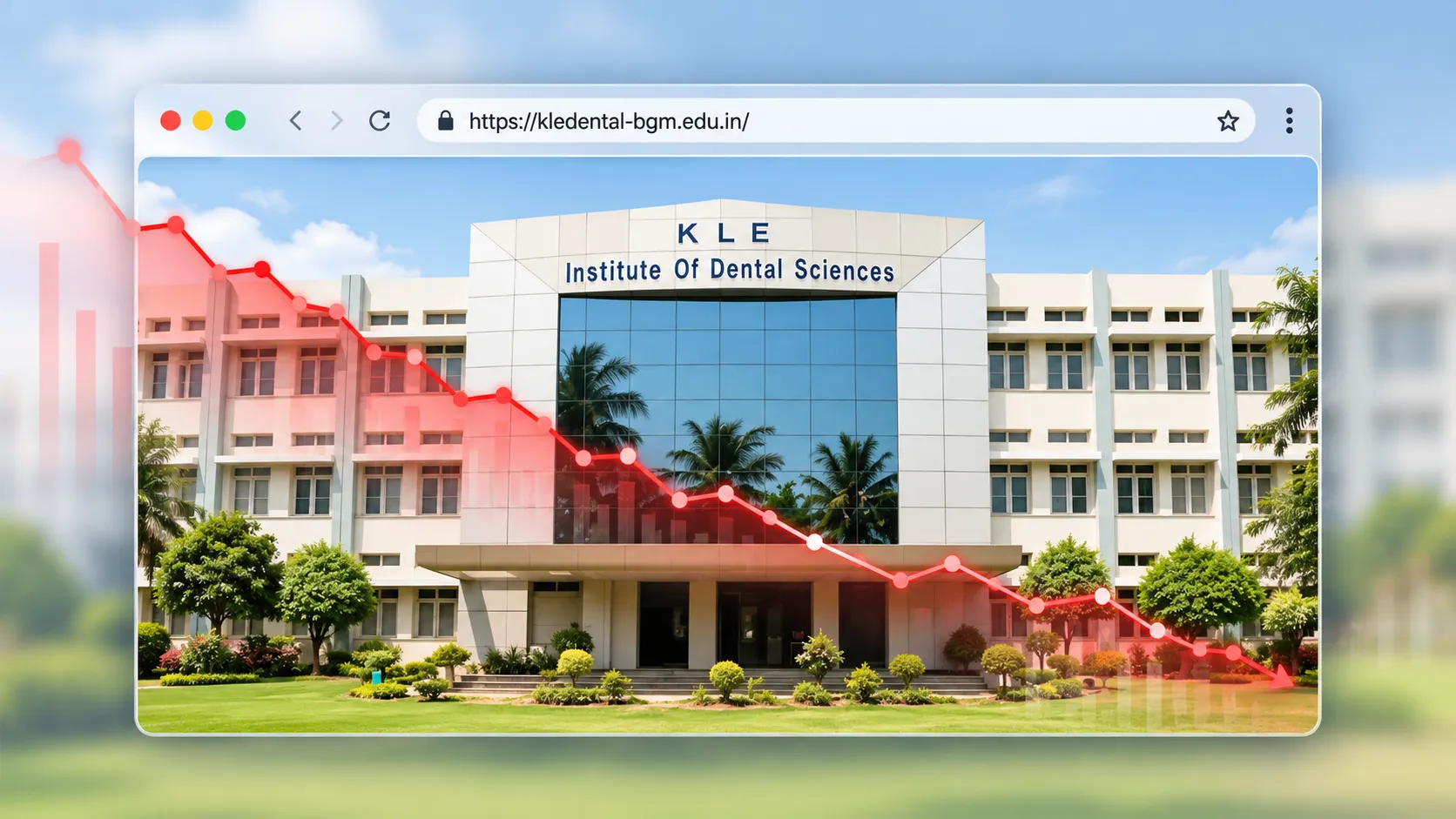
Website investigated: KLE Vishwanath Katti Institute of Dental Sciences and Hospital (kledental-bgm.edu.in)
Investigated by: Vikas Solanke | Web Design Hubli
Industry: Dental Education, Healthcare & Academic Institution
Investigation period: 2020–2026
Current website reviewed: October 2026
Nature of investigation: Historical website source code, gambling and unrelated spam content, indexed WordPress theme demo pages, URL architecture, missing H1 headings, technical SEO and organic keyword visibility analysis
A forensic review of kledental-bgm.edu.in reveals several technical and search visibility issues that deserve closer attention. These include gambling-related content appearing on the website, unrelated WordPress theme demonstration pages indexed by Google, missing H1 headings across 67 URLs identified in a crawl report, and a significant reduction in the number of organic keywords reported by SEMrush.
For an educational institution, a website serves a much bigger purpose than presenting information online. It helps prospective students and parents evaluate courses, allows researchers and faculty to find institutional information, and provides an important channel for communicating credibility.
This audit examines the available website source code snapshots, search results, crawl data and SEMrush ranking reports to understand what the evidence shows, what remains uncertain, and which corrective actions should take priority.
The objective is to document the findings and identify practical ways to improve website security, technical SEO and long-term search visibility. The findings do not, by themselves, establish who was responsible for any technical issue or how it originated.
1. Executive Summary
The audit identified four major areas requiring attention.
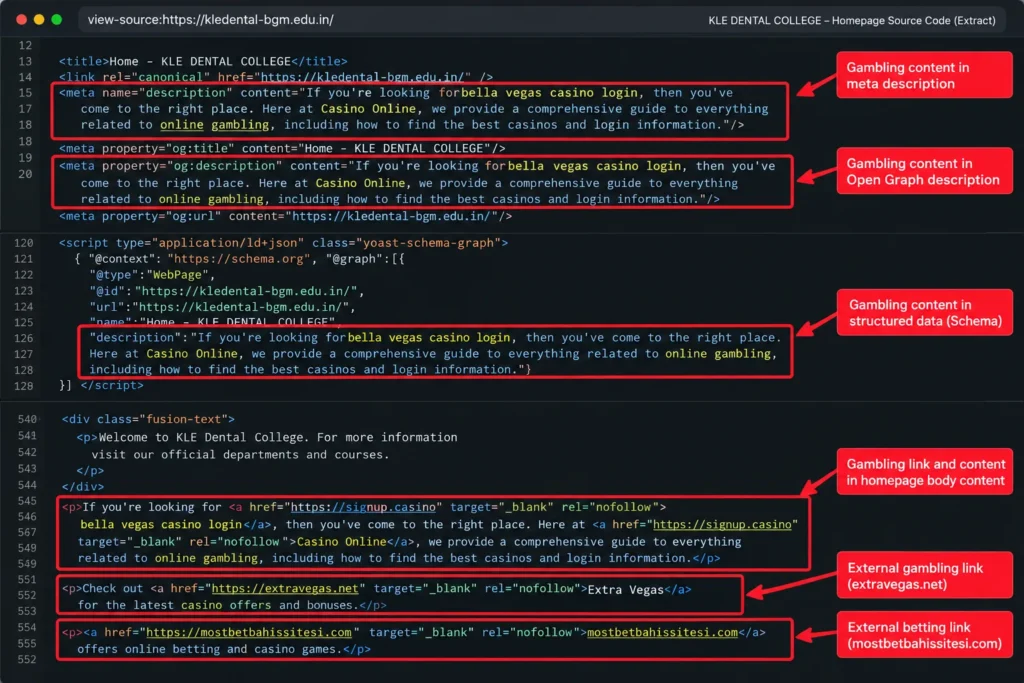
- Gambling and unrelated spam content: The current homepage contains gambling-related promotional content and links that are unrelated to dental education. Other unrelated promotional links were also visible during the review.
- Unrelated WordPress portfolio pages: The
/avada_portfolio/URL structure exposes generic theme demonstration content, including pages about Economics and Graphic Design. These pages have no apparent relevance to the institution’s dental education offering and are discoverable through Google Search. - Missing H1 headings: A supplied crawl export reports 67 indexable URLs without an H1 heading detected. The homepage and important academic, departmental, faculty and institutional pages are included.
- Reduced organic keyword visibility: SEMrush ranking data shows a decrease from 755 tracked organic keywords in August 2024 to 176 in October 2026.
These issues should not be treated as interchangeable. Spam content requires a security investigation and cleanup. Unrelated indexed pages require URL-level decisions. Missing headings require an on-page SEO review. The ranking decline requires further investigation before attributing it to any single cause.
2. Gambling and Unrelated Spam Content on the Website
One of the most serious findings is the presence of content unrelated to the institution’s purpose on its public-facing website.
During the live homepage review, gambling-related promotional text and external links were visible alongside legitimate institutional content. Other unrelated promotional links, including adult-content references, were also found.
This is not a minor wording or design issue. It raises questions about website integrity, content governance and the reliability of pages presented to search engines and visitors.
2.1 What the source code snapshots show
The supplied archived homepage source files provide a useful timeline.
| Archived snapshot | Technical observations | Gambling-related terms found |
|---|---|---|
| February 2020 | WordPress 5.1.3 references; theme and plugin assets from the earlier site setup | 0 |
| October 2020 | WordPress 5.4.2 references; Avada theme and Fusion Builder assets | 0 |
| September 2021 | Site Kit, Yoast SEO and Vijomi theme references | 0 |
| August 2024 | WordPress 6.6.1 references; gambling-related text appears in the page source | 15 |
| January 2025 | WordPress 6.7.1 references; gambling-related text remains in the source | 20 |
The term counts above are observations from the supplied archived HTML files. They are not a count of unique spam URLs, and they do not establish when the underlying issue first began.
The supplied snapshots show that the reviewed source was free of the searched gambling terms in September 2021, while the August 2024 and January 2025 snapshots contain them. Additional archived captures and server records would be needed to establish a more precise timeline.
The archived source also shows changes in WordPress versions, theme references and plugin assets over time. These changes are relevant to the technical investigation, but they do not independently prove how the spam content was introduced.
2.2 Why this matters for SEO
Spam content on an institutional website can create several problems:
- Search engines may discover and associate the domain with irrelevant topics.
- Visitors may encounter content that undermines confidence in the institution.
- Search results may display misleading titles or descriptions.
- Spam pages or links may consume crawling and indexing resources.
- The underlying issue may persist if the entry point or reinfection mechanism has not been identified.
The visible presence of spam does not, on its own, prove that Google has imposed a manual action or that the spam caused the entire ranking decline. Those possibilities should be investigated through Google Search Console and a technical security review.
3. Unrelated WordPress Theme Demo Pages Are Indexed by Google
Another significant finding concerns the URL structure:
https://kledental-bgm.edu.in/avada_portfolio
This appears to expose portfolio content associated with a WordPress theme or website template. The reviewed pages contain generic demonstration content rather than material about dentistry, dental education, research or the institution.
Two examples are:
The parent archive is also discoverable in Google Search.
3.1 What is on these pages?
The Economics page contains generic education-template copy, including the heading “Tomorrows Business Leaders,” followed by placeholder-style introductory text. The Graphic Design page uses a similar structure and generic content.
The portfolio archive displays a collection of unrelated subjects, including Music Production, Graphic Design, Economics, Sports Science, Biology and Physics.
These subjects and descriptions do not correspond to the dental institution’s stated academic purpose.
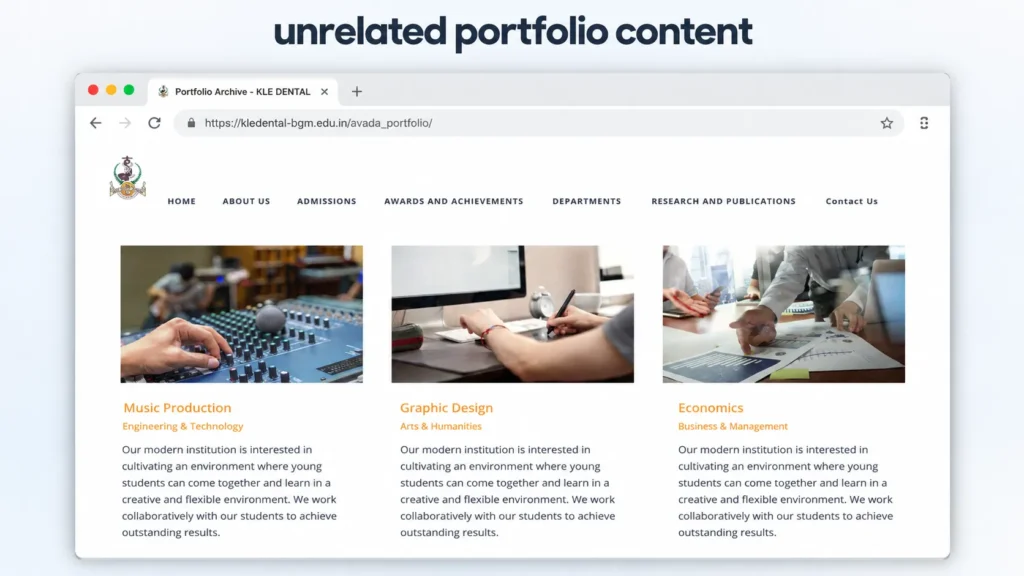
The pages also contain navigation elements associated with the institution’s current website, which makes the unrelated content appear within the same domain rather than on a separate demonstration website.
3.2 Why these pages are a technical SEO concern
The problem is not simply that the pages look outdated. The more important question is why these URLs remain publicly accessible and discoverable by search engines.
Potential consequences include:
- Search engines spending time crawling pages with little or no institutional value.
- Irrelevant pages appearing in branded or non-branded search results.
- Unnecessary duplication of generic template text across multiple URLs.
- A less coherent set of pages representing the website’s subject matter.
- Additional cleanup work if these pages were created unintentionally or have been left behind after a theme or design change.
It would be premature to claim that these pages alone caused a ranking decline. Their relevance and indexing status should instead be assessed as part of the wider technical SEO audit.
3.3 What should be done with the portfolio URLs?
The correct solution depends on whether these URLs have any legitimate purpose or useful external links.
The recommended process is:
- Inventory all URLs under
/avada_portfolio/, including individual portfolio items and archive pages. - Check Google Search Console for impressions, clicks, indexing status and any reported security issues associated with these URLs.
- Review backlinks and internal links to determine whether any pages have legitimate value.
- Identify whether the pages are still generated by the active theme, a plugin, database content or another part of the WordPress installation.
- Remove or disable the unwanted content at its source.
- Return an appropriate HTTP status for URLs that should no longer exist, or redirect them only when a genuinely relevant replacement exists.
A blanket redirect of every unwanted URL to the homepage is not recommended. A redirect should make sense for the original URL and the destination. If no relevant replacement exists, a proper 404 or 410 response may be appropriate.
Adding noindex can be useful for pages that must remain accessible but should not appear in search results. It is not a substitute for removing unwanted content or fixing a possible security issue.
4. SEMrush Data Shows a Significant Reduction in Organic Keyword Visibility
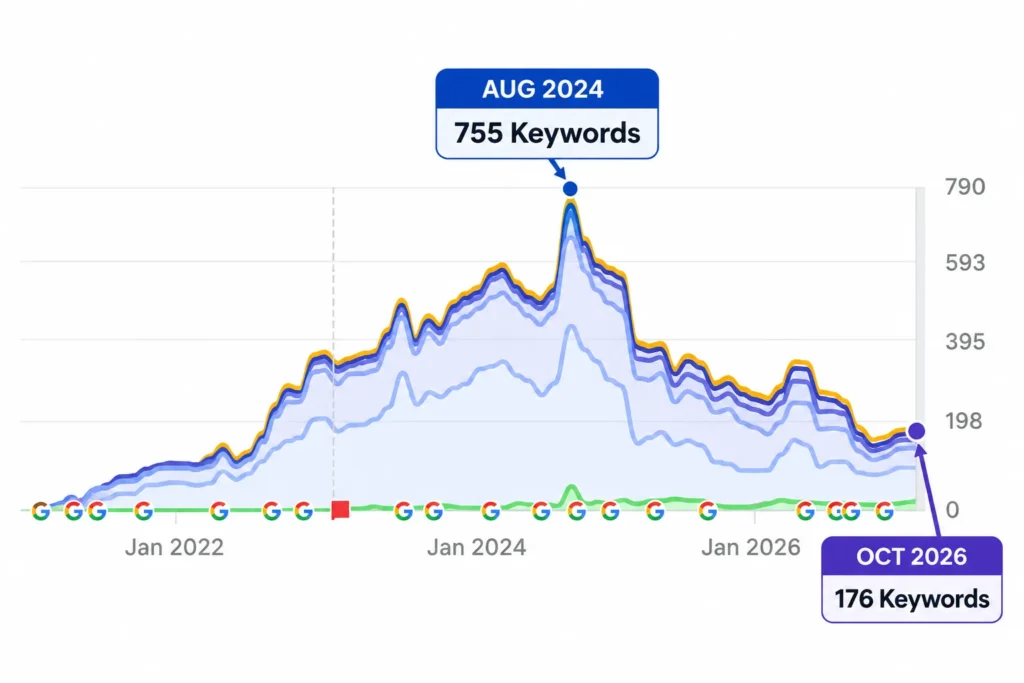
The supplied SEMrush screenshots provide a second important line of evidence: the number of tracked organic keywords has decreased substantially.
The August 2024 report shows 755 organic keywords, compared with 176 in October 2026.
4.1 Ranking distribution comparison
| Google ranking position | August 2024 | October 2026 | Change |
|---|---|---|---|
| Top 3 | 11 | 19 | +8 |
| Positions 4 to 10 | 23 | 16 | -7 |
| Positions 11 to 20 | 60 | 26 | -34 |
| Positions 21 to 50 | 225 | 43 | -182 |
| Positions 51 to 100 | 379 | 53 | -326 |
| Total organic keywords | 755 | 176 | -579 |
Based on these screenshots, the total number of tracked organic keywords fell by approximately 76.7%.
The number of tracked keywords in positions 11 to 100 declined from 664 to 122, a reduction of approximately 81.6%.
There is an important qualification: the combined number of keywords in the top 10 increased slightly, from 34 to 35. The top-three count also increased from 11 to 19. This means the data does not show a uniform decline across every ranking position.
Instead, the clearest pattern is a substantial reduction in the number of keywords appearing across positions 11 to 100, alongside a smaller number of keywords remaining in the top positions.
4.2 What the numbers do and do not establish
SEMrush keyword counts are estimates based on the tool’s keyword database and tracking methodology. They are not the same as website traffic, Google Search Console clicks, enquiries or admissions.
The screenshots support the conclusion that SEMrush reported far fewer ranking keywords in October 2026 than in August 2024. They do not establish that organic traffic fell by 76.7%, nor do they identify the cause of the decline.
Possible areas for investigation include:
- Changes in indexed URLs and the content available to search engines.
- Technical SEO errors, including canonical, redirect and indexation problems.
- The relevance and quality of pages targeting important academic and institutional searches.
- Search demand and changes in the competitive landscape.
- The timing and extent of the spam issue.
- Changes in SEMrush’s keyword database or reporting methodology.
Google Search Console performance data, historical indexing reports and a complete URL-level comparison would help distinguish between these possibilities.
5. Missing H1 Headings Across 67 Indexable URLs
The supplied crawl export reports 67 indexable URLs for which no H1 heading was detected.
The affected URL list includes important sections of the website, such as the homepage, courses, departments, faculty profiles, research and publications, campus facilities, contact information and institutional disclosures.
Examples from the report include:
https://kledental-bgm.edu.in/https://kledental-bgm.edu.in/courses/https://kledental-bgm.edu.in/departments/https://kledental-bgm.edu.in/contact-us/https://kledental-bgm.edu.in/master-of-dental-surgery-mds/https://kledental-bgm.edu.in/bachelor-of-dental-surgery-bds/https://kledental-bgm.edu.in/campus-facilities/https://kledental-bgm.edu.in/mandatory-disclosure/
The complete list should be retained as an audit appendix or working spreadsheet so that each URL can be checked and corrected systematically.
5.1 Why H1 headings matter
The H1 is the main visible heading that helps communicate the subject of a page. A clear, relevant H1 can improve content structure and help users understand what a page covers.
For example:
| Page | Suggested H1 |
|---|---|
| Homepage | KLE Vishwanath Katti Institute of Dental Sciences and Hospital |
| Courses | Dental Courses Offered at KLE Dental College |
| Departments | Dental Departments at KLE Dental College |
| Contact Us | Contact KLE Dental College, Belagavi |
| Bachelor of Dental Surgery | Bachelor of Dental Surgery (BDS) |
| Master of Dental Surgery | Master of Dental Surgery (MDS) |
| Campus Facilities | Campus Facilities at KLE Dental College |
| Mandatory Disclosure | Mandatory Disclosure and Institutional Information |
These are suggested heading formulations, not a substitute for confirming each page’s official naming and purpose.
5.2 How this should be fixed
The missing-heading report should be treated as a page-level technical SEO task rather than an instruction to insert the same heading everywhere.
For each affected URL:
- Confirm the page’s primary purpose.
- Add a descriptive H1 that accurately reflects the visible content.
- Ensure the heading is present in the rendered page and accessible to search engines.
- Review the page’s title tag, meta description and secondary headings for consistency.
- Check the page template to determine whether a shared layout or component is responsible for the missing heading.
- Re-crawl the website to verify that the issue has been resolved.
A missing H1 does not automatically mean a page cannot rank. The issue is the lack of a clear primary heading on pages where one would be useful, particularly when combined with other content and technical problems.
6. How the Findings Fit Together
The audit identifies several problems, but they should not be combined into a single assumed cause.
The spam content raises a security and content-integrity concern. The portfolio URLs indicate that irrelevant template content is publicly accessible and indexed. The missing H1 report identifies an on-page SEO weakness across a broad set of URLs. The SEMrush screenshots show a reduction in tracked organic keyword visibility.
These findings justify a coordinated investigation, but the available evidence does not prove that one of these issues caused all the others.
A more reliable assessment would combine the following:
- Historical website source code and archive captures.
- A complete crawl of current and historical URLs.
- Google Search Console Performance data.
- Google Search Console Page Indexing and Security Issues reports.
- The Manual Actions report.
- Server, database and file-system checks if unauthorised changes are suspected.
- A comparison of important landing pages, their indexation status and their search performance.
This approach makes it possible to separate confirmed defects from hypotheses and establish the sequence of events more accurately.
7. Institutional Risk: Why These Website Issues Matter Beyond SEO
For an educational institution, a website is more than a source of organic traffic. It is a public-facing representation of the institution, its academic programmes and its credibility.
The findings in this audit therefore deserve attention beyond their potential effect on search rankings. Unrelated gambling content, adult-content references and irrelevant indexed pages can create reputational and operational concerns, particularly when they appear on a domain that prospective students, parents, faculty members, researchers and other stakeholders expect to represent an educational institution.
7.1 Reputational Risk
Visitors who encounter gambling promotions or unrelated adult-content references on an institutional website may question the reliability of the information they are viewing. Even if the content is unrelated to the institution’s actual activities, its presence on the official domain can create an unfavourable impression.
This is especially important during the admissions process, when prospective students and parents may use the website to evaluate courses, facilities, faculty and institutional information.
The audit confirms that unrelated promotional content was visible during the review. The extent to which this has affected public perception has not been measured.
7.2 Search Visibility and Discoverability Risk
Irrelevant pages and injected content can make it harder to maintain a clean, coherent search presence. Search engines may discover pages that do not serve the institution’s intended audience, while users may encounter results that do not accurately represent its academic focus.
The indexed /avada_portfolio/ pages demonstrate this problem in practical terms. Generic pages about Economics, Graphic Design and other unrelated subjects are discoverable under the institution’s domain.
The reported reduction in SEMrush keyword visibility adds another reason to investigate the site’s search performance. However, the available data does not establish that the spam content or portfolio pages caused the decline.
7.3 Website Security and Content Integrity Risk
The presence of unrelated promotional material raises a question that cannot be answered through an SEO crawl alone: how is this content being added or served?
Possible explanations require technical investigation. The current evidence does not establish whether the content resulted from unauthorised access, a configuration issue, retained demonstration content or another cause.
Until the source is identified, removing visible spam should not be treated as proof that the website is secure. A review of WordPress accounts, themes, plugins, files, database content, scheduled tasks and hosting access is necessary to determine whether further corrective action is required.
7.4 Risk to Prospective Students and Other Website Visitors
Visitors rely on institutional websites to find accurate information about admissions, programmes, academic departments, facilities and contact details.
Unrelated content can distract from this purpose and make the website less dependable as an information channel. Unexpected links also warrant examination to determine whether they lead to unsafe, misleading or inappropriate destinations.
The audit establishes that unrelated content and links were present. It does not establish that visitors were redirected, that personal information was exposed, or that any particular visitor suffered harm. Those questions would require additional technical evidence.
7.5 Operational and Governance Risk
If unwanted content remains accessible or reappears after removal, the institution may need to devote additional time and resources to security investigation, content cleanup, search-result correction and ongoing monitoring.
A clear process for managing website access, approving content changes, updating software and reviewing unexpected changes can help reduce these risks.
Responsibility for implementing those controls should be established through the institution’s existing website management arrangements. The findings in this audit do not, by themselves, establish responsibility for the content or the circumstances in which it appeared.
7.6 Recommended Institutional Response
The following actions should be prioritised:
- Verify and contain the issue: Investigate the spam content, preserve appropriate evidence and determine whether any unauthorised changes occurred.
- Protect the public-facing website: Review access controls, software updates, backups and monitoring arrangements.
- Remove unrelated content: Identify unwanted portfolio pages and promotional URLs, then apply the appropriate removal or redirection strategy.
- Check search engine exposure: Review indexed URLs, Google Search Console security reports and manual actions, and monitor the removal of unwanted results.
- Restore content quality: Resolve the missing H1 headings and review important institutional pages for accurate, useful and consistent information.
- Establish ongoing oversight: Assign clear ownership for website security, content approval, technical maintenance and periodic SEO audits.
The institutional priority should be to restore confidence in the website as a reliable source of academic information. Search visibility recovery is important, but it should follow a verified cleanup and a clear understanding of the underlying technical issues.
8. Recommended Recovery and Technical SEO Plan
The order of work matters. Improving headings and metadata will not resolve an underlying compromise, and removing unwanted URLs without examining their history may discard pages that have legitimate search value.
Phase 1: Investigate and secure the website
The first priority is to identify how the unrelated content is being served and whether the underlying source remains active.
Recommended checks include:
- Take a complete backup of the website and database before making changes.
- Review WordPress administrator accounts, hosting access and database users.
- Inspect active themes, plugins, must-use plugins, configuration files and scheduled tasks.
- Search the database and file system for suspicious injected content and unfamiliar external links.
- Review access logs and recent file changes where available.
- Update or replace vulnerable software after confirming compatibility.
- Rotate relevant passwords and credentials, revoke unrecognised sessions and enable stronger access controls.
- Check Google Search Console’s Security Issues and Manual Actions reports.
If a compromise is confirmed, cleaning the visible homepage alone is insufficient. The source of the content and any mechanism that could restore it must also be addressed.
Google provides guidance on hacked sites and injected content and on security issues in Search Console.
Phase 2: Audit URLs and remove irrelevant indexed content
Once the security investigation is underway, compile an inventory of all URLs that should exist on the website.
Classify each URL as one of the following:
- Legitimate institutional page that should remain indexed.
- Legitimate page requiring content or technical improvements.
- Unwanted theme demo page that should be removed.
- Malicious or injected URL requiring cleanup.
- Retired page with a relevant replacement.
- Retired page without a relevant replacement.
Use that classification to determine whether each URL should remain accessible, be redirected to a genuinely relevant replacement, or return a 404 or 410 status.
Check internal links, XML sitemaps, canonical tags and robots directives after the changes. Where necessary, use Search Console to monitor how Google processes the corrected URLs.
Phase 3: Correct on-page and technical SEO issues
The 67 URLs in the H1 report should be checked and resolved systematically.
The wider review should also cover:
- Unique and descriptive title tags.
- Appropriate meta descriptions.
- Clear H1 and H2 heading structures.
- Canonical tags and indexation directives.
- Internal links between related academic pages.
- XML sitemap accuracy.
- Redirect chains and broken links.
- Mobile usability and page performance.
- Structured data where appropriate and supported by the visible content.
The aim is not to add keywords mechanically. It is to ensure that each page has a clear purpose, a logical structure and accurate information for both visitors and search engines.
Phase 4: Measure search performance and rebuild visibility
Once the website is secure and the technical corrections have been verified, establish a baseline for ongoing monitoring.
Track:
- Google Search Console clicks and impressions.
- Search queries associated with admissions, courses, departments and faculty.
- Indexing trends for important landing pages.
- The presence of spam-related URLs in search results.
- Organic traffic to priority pages.
- Enquiry and admission-related conversions where measurement is available.
Compare the data over time rather than judging recovery solely from a single keyword-count report.
A recovery strategy should focus first on protecting the integrity of the existing website and its valuable pages, then on improving content and search visibility based on measured results.
9. Conclusion
The KLE Dental College website audit identifies a combination of security-related concerns, irrelevant indexed content and technical SEO weaknesses.
The most urgent finding is the presence of unrelated gambling and promotional content on the public website. The indexed /avada_portfolio/ pages are another clear cleanup priority because they expose generic template content that has no apparent connection to the institution’s core purpose.
Separately, the supplied crawl report identifies 67 indexable URLs without a detected H1 heading. SEMrush data shows that tracked organic keyword visibility fell from 755 keywords in August 2024 to 176 in October 2026, although the top-10 keyword count remained broadly stable.
The next step is not to assume that any one finding explains the entire ranking decline. It is to secure the website, establish the full extent of the affected URLs, correct the technical issues and use Search Console and historical data to measure the outcome.
A structured, evidence-led recovery process gives the institution a clearer path toward a cleaner website, more relevant search results and a stronger technical foundation for future organic visibility.
Audit note: This assessment is based on the archived homepage source files, the provided SEMrush screenshots and crawl export, and the public pages reviewed during the audit. Server logs, WordPress administration data and Google Search Console access were not part of the supplied evidence. The precise origin of the spam and its contribution to the keyword decline therefore remain unconfirmed.
Planning a website project?
See our work or tell us what you're building.